Latest Meeting Report:
Meeting Report of the Ipswich and District Historical Transport Society on September 23rd 2026.
A total of 47 members and visitors attended the first meeting of our season.
After the AGM the subject of the talk at this meeting was: “The Life, Work and Legacy of William Armstrong”. The speaker was Roy Dowding.
William George Armstrong was born in Newcastle upon Tyne on the 26th November 1810. Within ten miles of that other great engineer: George Stephenson. Armstrong later straddled all the fields of engineering, including civil, mechanical, electrical and structural engineering.
Armstrong at sixteen years of age was sent to Bishop Auckland Grammar school. While there, he often visited the nearby engineering works of William Ramshaw. During his visits, he met his future wife, Ramshaw's daughter Margaret, six years his senior.
Armstrong's father was set on his following a career in the law, and so he was articled to Armorer Donkin, a solicitor friend of his father. Armstrong worked as a solicitor for eleven years but his time at Ramshaw’s works had given him an abiding interest in engineering.
His first project was to design a rotary engine powered by water, and this was built in the High Bridge works of his friend Henry Watson. Little interest was shown in the engine. Armstrong subsequently developed a piston engine instead of a rotary one and decided that it might be suitable for driving a hydraulic crane.
In 1845 a scheme was set in motion to provide piped water from distant reservoirs to the households of Newcastle. Armstrong was involved in this scheme and he proposed to Newcastle Corporation that the excess water pressure in the lower part of town could be used to power a quayside crane specially adapted by himself. He claimed that his hydraulic crane could unload ships faster and more cheaply than conventional cranes. The Corporation agreed to his suggestion, and the experiment proved so successful that three more hydraulic cranes were installed on the Quayside.
The success of his hydraulic crane led Armstrong to consider setting up a business to manufacture cranes and other hydraulic equipment. He therefore resigned from his legal practice. Donkin, his legal colleague, supported him in his career move, providing financial backing for the new venture. In 1847 the firm of W. G. Armstrong & Company bought 51/2 acres of land alongside the river at Elswick, near Newcastle, and began to build a factory there. The new company received orders for hydraulic cranes from Edinburgh and Northern Railways and from Liverpool Docks. The company soon began to expand. In 1850 the company produced 45 cranes and two years later, 75. It averaged 100 cranes per year for the rest of the century. In 1850 over 300 men were employed at the works, but by 1863 this had risen to 3,800. The company soon branched out into bridge building, one of the first orders being for the Inverness Bridge, completed in 1855.
In 1852 he built a hydraulic accumulator tower and maritime landmark at the entrance to the Royal Dock in Grimsby. It was based on Armstrong’s idea of the hydraulic accumulator. It contained 30,000 gallons of water and was 200 feet high. It was used to provide hydraulic power to work the machinery used in Grimsby Docks. The extreme height of the tower was necessary to achieve sufficient pressure, and as a result of this, the tower can be seen for several miles around,
He designed the Newcastle Swing Bridge, with an innovative hydraulic system to swing open and close, this enabled ships to sail further up river. He was also involved with the building of the hydraulic mechanism that operates Tower Bridge in London.
He created Cragside, his residence near Rothbury, Northumberland, which was the first house in the world to be lit by hydroelectricity.
He made a vital contribution to the understanding of renewable energy, especially his experiments with hydroelectricity and harnessing the power of the sun.
Armstrong became one of Britain’s largest industrialists and one of the richest people in Europe, enabling his significant philanthropy. He is sometimes referred to as the 'inventor of modern artillery' by designing a lighter, more mobile field gun, with greater range and accuracy. He built a breech-loading gun with a strong, rifled barrel made from wrought iron wrapped around a steel inner lining, designed to fire a shell instead of a ball. This was used during the Crimean War in the 1850’s.
Armstrongs merged with the shipbuilding firm of Mitchell to become Armstrong Mitchell in 1882. This became Armstrong Whitworth through mergers. In 1927, it merged with Vickers Limited to form Vickers-Armstrongs, with its automobile and aircraft interests purchased by J D Siddeley.
In 1960 the aircraft interests were merged with those of Bristol, English Electric and Hunting Aircraft to form the British Aircraft Corporation (BAC). The Vickers brand name for aircraft was dropped by BAC in 1965. Under the terms of the Aircraft and Shipbuilding Industries Act 1977 BAC was nationalised to become part of British Aerospace (later BAE Systems).
As for Mr Armstrong, who began it all: he died in 1900 at the age of 90.
Roy received thanks from our Chairman and warm applause from the floor for his talk.
Mervyn Russen

Roy Dowding (with his permission)
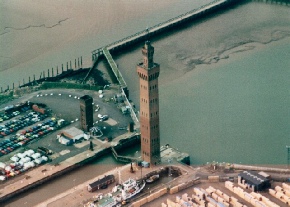
Grimsby Dock Tower (Attribution to Colin Westley)
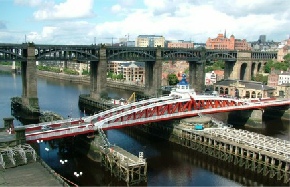
High level swing bridge in Newcastle-upon-Tyne (Attribution - Creative Commons Attribution-Share Alike 3.0 Unported license)
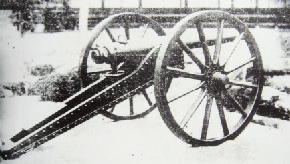
Sagahan Armstrong gun used at the Battle of Ueno in Japan in 1868 (In the public domain)
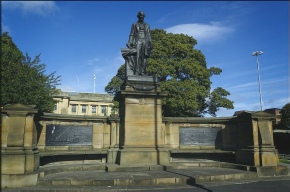
Statue of Armstrong in Newcastle-upon-Tyne (Attribution - Creative Commons Attribution-Share Alike 3.0 Unported license)